
When investigating mold contamination in buildings, many inspectors rely on spore trap air samples. While spore testing can provide useful information, it often misses an important part of mold exposure: microscopic fungal fragments.
Research over the past two decades shows that fungal fragments can be far more numerous than intact spores, and these particles often contain β-glucans, a key biomarker of fungal material.
Because of this, mold beta-glucan testing is increasingly used in indoor air quality (IAQ) investigations to detect hidden fungal contamination that traditional spore counts may overlook.
What Are Beta-Glucans?
β-glucans are structural polysaccharides found in fungal cell walls. They are present in:
- Mold spores
- Fungal hyphae (the branching structures that form mold colonies)
- Fungal fragments and microscopic debris
When mold grows on building materials or when moldy materials degrade, these particles become airborne or settle into household dust.
Because β-glucans are part of the fungal cell wall, they serve as a marker of total fungal biomass.
Why Mold Beta-Glucan Testing Matters
Traditional mold testing methods measure only intact spores. However, multiple studies have shown that spores represent only a portion of airborne fungal particles.
Research by aerosol scientists Dr. Tiina Reponen, Dr. S. A. Grinshpun, and colleagues demonstrated that fungal fragments can be released during mold growth and mechanical disturbance.
In controlled aerosolization experiments, researchers found that fungal fragments could outnumber spores by hundreds of times (Górny et al., 2002).
These fragments often measure less than 1 micron, allowing them to penetrate deep into the lungs.
Scientific Evidence Behind Beta-Glucan Testing
Several major studies have established the importance of fungal fragments and β-glucans in indoor environments.
Fungal Fragments as Indoor Air Biocontaminants
Górny RL, Reponen T, Grinshpun SA, Willeke K.
Applied and Environmental Microbiology (2002)
This landmark study demonstrated that fungal fragments are released along with spores and may occur at concentrations hundreds of times higher than spores.
Citation:
Górny RL, Reponen T, Willeke K, Schmechel D, Robine E, Boissier M, Grinshpun SA. 2002. Fungal fragments as indoor air biocontaminants. Applied and Environmental Microbiology 68(7):3522-3531.
Fungal Fragments in Moldy Houses
Reponen T., Adhikari A., et al.
Atmospheric Environment (2007)
This field study measured airborne fungal fragments in mold-affected homes and confirmed the presence of submicron fungal particles in indoor air.
Citation:
Adhikari A, Reponen T, Grinshpun SA, Martuzevicius D, LeMasters G. 2007. Fungal fragments in moldy houses. Atmospheric Environment.
Beta-Glucans and Respiratory Health
Rylander R.
Indoor Air (1997; 2010 reviews)
Dr. Ragnar Rylander conducted pioneering work on β-glucans as inflammatory agents, demonstrating their role in respiratory irritation and immune activation.
Citation:
Rylander R. 1997. Airborne β-glucan and respiratory disease. Indoor Air.
Together, these studies established that fungal fragments containing β-glucans are a major component of indoor mold exposure.
Spores vs Fungal Fragments
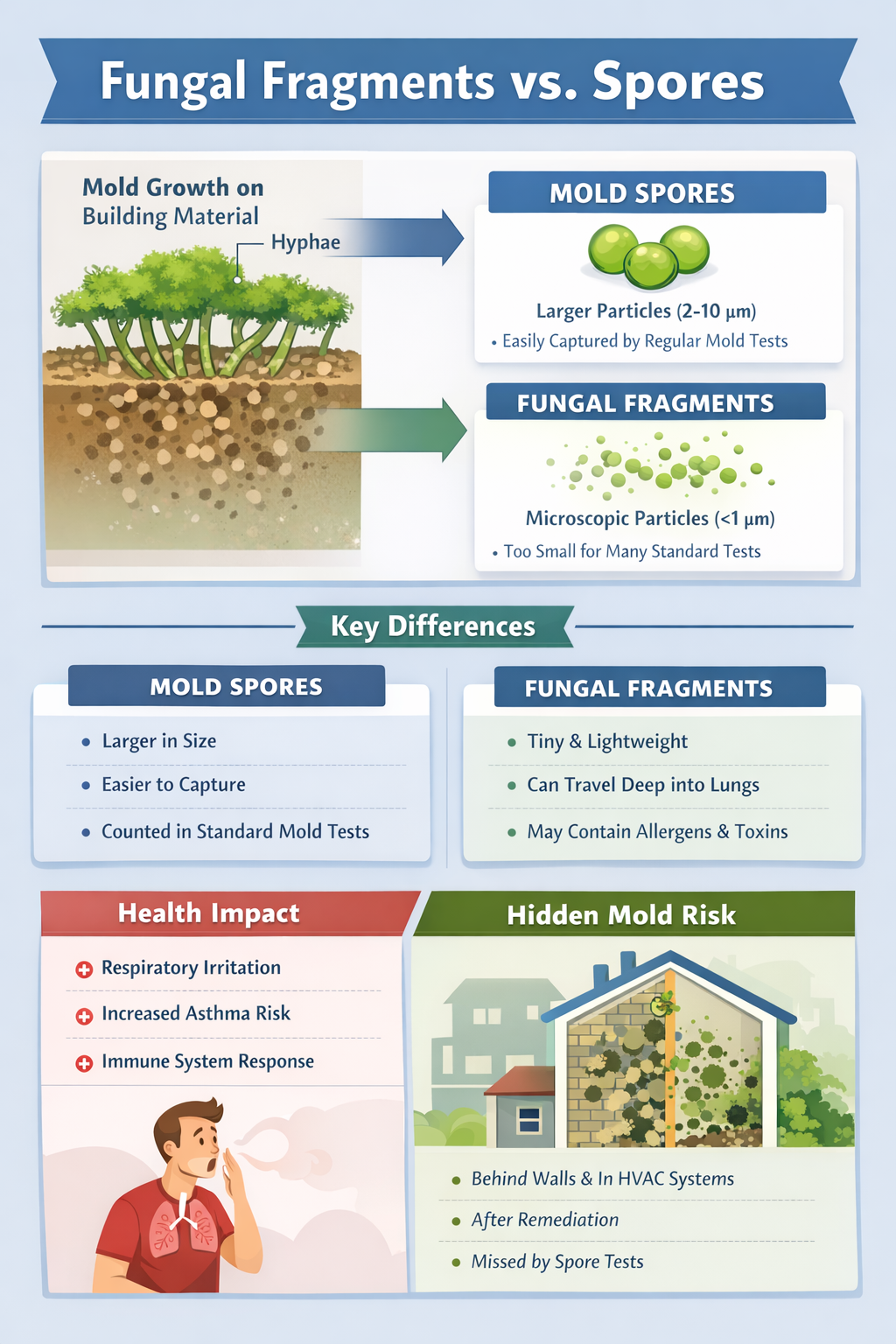
Traditional mold tests primarily measure spores, but buildings also contain many microscopic fragments.
Because fragments are often much smaller than spores, they remain airborne longer and can travel throughout buildings.
What Mold Beta-Glucan Testing Detects
β-glucan testing measures total fungal biomass, including:
- Spores
- Hyphal fragments
- Degraded fungal debris
- Microscopic fungal dust
This makes it useful for detecting hidden mold problems.
Common scenarios where beta-glucan testing helps include:
Hidden Mold in Wall Cavities
Mold growing inside walls may release fragments even when spores are not detected.
Post-Remediation Evaluation
Beta-glucans can identify residual fungal dust remaining after remediation.
Buildings with Symptoms but Low Spore Counts
Occupants may react to fragments rather than spores.
Laboratories Offering Mold Beta-Glucan Testing
Several environmental laboratories offer β-glucan analysis for indoor air quality investigations.
EMSL Analytical
Large international environmental laboratory.
Typical price:
$80 – $150 per sample
Services include:
- Dust beta-glucan analysis
- Air filter analysis
- Environmental microbiology testing
Eurofins EMLab P&K
One of the largest mold testing labs in North America.
Typical price:
$100 – $180 per sample
They provide a full range of IAQ services including:
- mold spore analysis
- fungal biomass markers
- building investigations
Mycometrics
Specialized microbial testing laboratory focusing on fungal contamination.
Typical price:
$120 – $200 per sample
Offers assays for fungal biomass markers including β-glucans and ergosterol.
Environmental Diagnostics Laboratory (EDLab)
Environmental testing laboratory providing advanced IAQ analyses.
Typical price:
$100 – $200 per sample
Limitations of Beta-Glucan Testing
While beta-glucan testing is useful, it does have limitations:
- It does not identify specific mold species
- It cannot determine whether contamination is active or historical
- Small amounts may originate from non-fungal organic materials
Because of these limitations, most investigators use beta-glucan testing alongside other diagnostic methods.
Best Practice for Mold Investigations
The most effective building investigations combine several techniques:
- Visual inspection
- Moisture mapping
- Spore trap air sampling
- Dust testing (ERMI / HERTSMI-2)
- Mold beta-glucan testing
This multi-method approach provides a more complete understanding of fungal contamination.
Final Thoughts
Scientific research over the past two decades has shown that mold exposure is not limited to spores. Microscopic fungal fragments—often containing β-glucans—can be present at much higher concentrations and may play an important role in indoor air quality and occupant health.
Because of this, mold beta-glucan testing is becoming an important tool for detecting hidden mold contamination in buildings.
For inspectors, industrial hygienists, and building scientists, beta-glucan testing can provide valuable insight into total fungal biomass and residual mold contamination that traditional testing methods may miss.
Key References
Górny RL, Reponen T, Willeke K, et al. 2002. Fungal fragments as indoor air biocontaminants. Applied and Environmental Microbiology.
Adhikari A, Reponen T, Grinshpun SA, et al. 2007. Fungal fragments in moldy houses. Atmospheric Environment.
Rylander R. 1997. Airborne β-glucan and respiratory disease. Indoor Air.
Related Posts
The Debilitating Path of Environmental Illness — And Why So Many Homes “Test Clean”

HVAC Systems: The Silent Distributor of Contamination

Why Your Last Mold Inspection Found Nothing (But You’re Still Sick)

Danger Level 3: Toxic Compounds — The Invisible Indoor Pollutants with Serious Health Risks

Danger Level 2: Infectious Agents — When Indoor Air Carries Illness
